A key component of Law Rocks’ mission is to promote youth music education. In 2023, the Law Rocks Board founded the Music Matters grant, given to a local nonprofit that supports youth music education in each of our US tour cities. Omi Crawford, Executive Director of Law Rocks, says of the grant initiative:
“Law Rocks has always been about championing nonprofits, especially local organizations that make a real difference in their community. The Music Matters grant deepens that commitment, helping support music education organizations nationwide as they change young lives through the power of music. It’s inspiring and exciting to learn more about each organizations work, truly one of the best things about this work!”
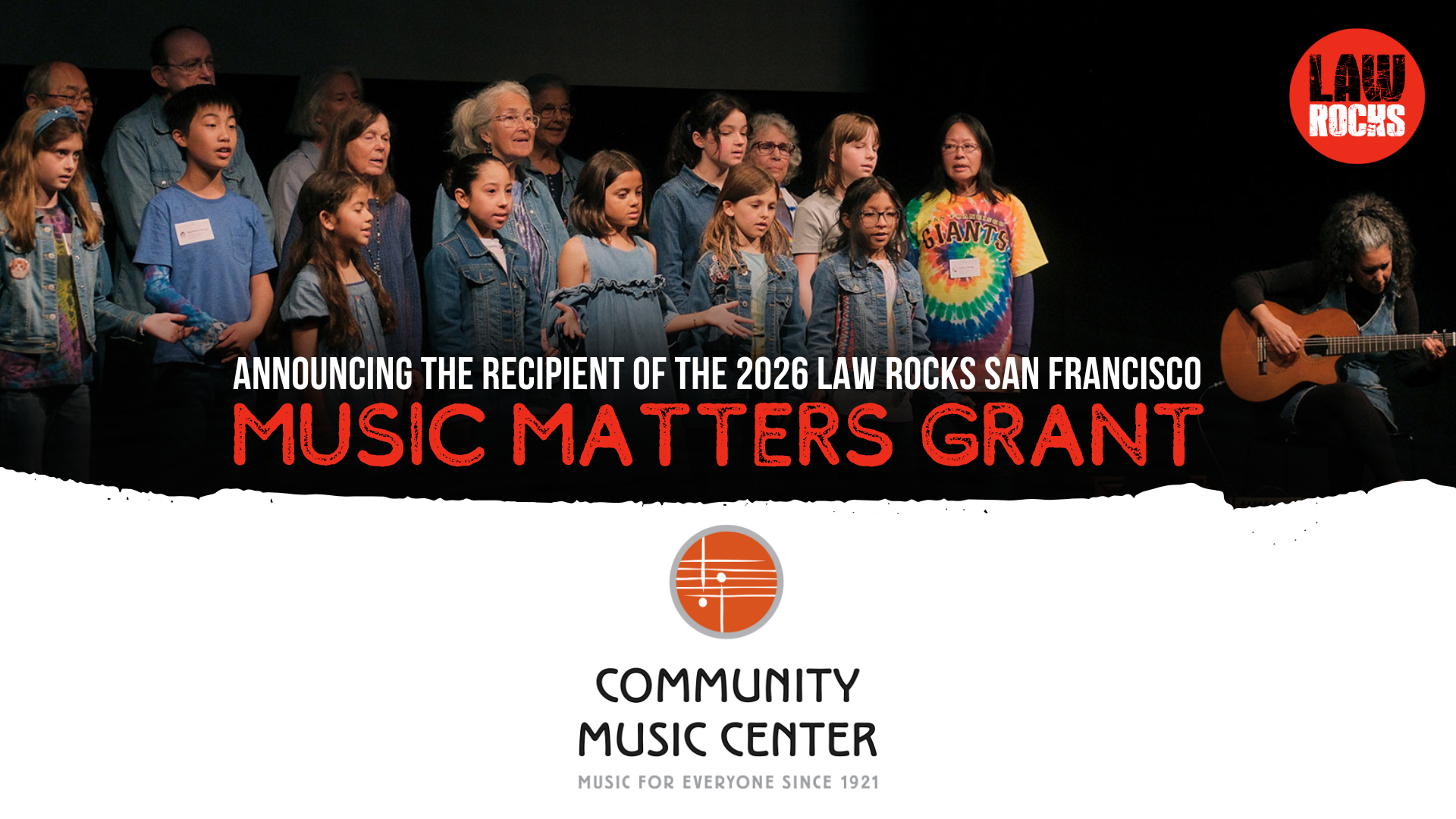
Law Rocks is back in the Bay Area on March 19, 2026, rocking The Great American Music Hall with the local legal community. We are pleased to be awarding a Music Matters grant to Community Music Center, a cornerstone San Francisco cultural institution and a vital hub for music education and performance anchored in the Mission District. Community Music Center (CMC) makes high-quality music accessible to people of all ages, backgrounds and abilities, regardless of financial means. Read on to learn more in our Nonprofit Spotlight interview with CMC.
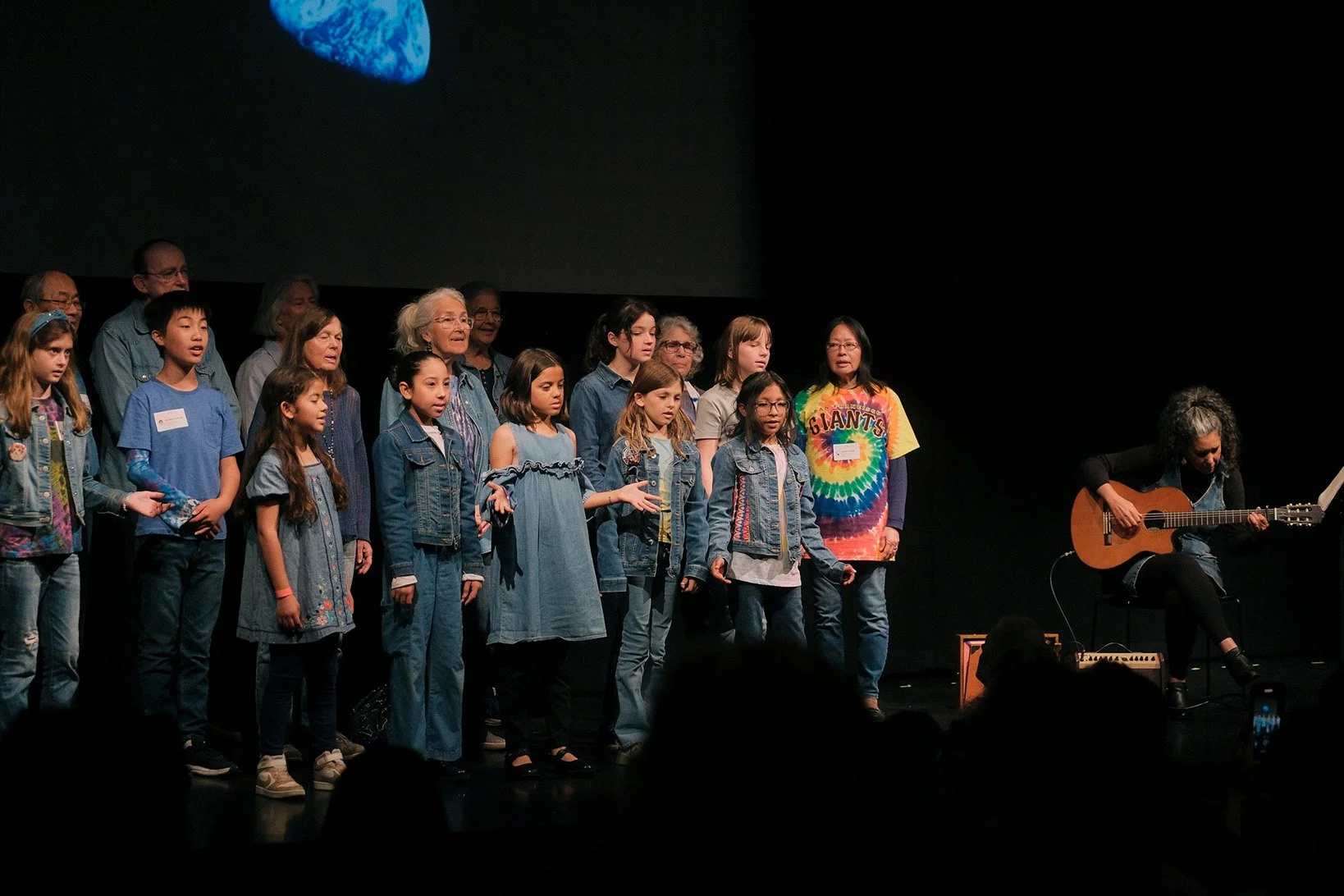
2026 Law Rocks San Francisco Music Matters Grant Recipient: Community Music Center | Photo by Frank Nuñez/Vivid KZ | Courtesy of CMC.
1) Can you tell us a little about the history of your nonprofit, as well as its mission and focus?
CMC is a deeply rooted San Francisco institution, launched in 1921 by neighbors for neighbors. Its first students were children of recent immigrants living in the Mission District. They gathered with their families in a Victorian home at 544 Capp Street, where music became a vehicle for connection, cultural expression, and community-building. 105 years later, CMC still operates from this same address and ethos, in an expanded campus that includes a second historic home, also preserved and restored with the community's support. Our deep and consistent partnerships with Mission District organizations enable CMC students to engage with the community through performances, recognize themselves as culture bearers, and participate directly in cultural organizing. Our presence in communities ensures that our programs grow in dialogue with the people we serve, allowing us to reflect their evolving needs, traditions, and aspirations. We remain accountable to the people we serve by showing up consistently and building programs that reflect the cultural and generational richness of San Francisco.
CMC’s offerings to students of all ages are many and varied, developed in response to community needs. Faculty develop strong relationships with students to customize teaching to support student learning styles and goals, and refer them to CMC opportunities to learn theory, play in ensembles, and perform.
The organization offers tuition-free programs for children and youth, older adults, and historically marginalized people including:
The Neighborhood Choir Program, presented in partnership with 17 senior and community centers throughout San Francisco and in collaboration with the SF Department of Disability and Aging Services.
The New Voices Bay Area TIGQ Chorus for transgender, intersex, and gender-queer singers.
The Young Musicians Program (YMP) was founded in 1987 and offers a comprehensive music education, outside of school time, to 97 middle and high school students aged 11-18, in their choice of Western classical, jazz, or Latin music.
The Teen Jazz Orchestra (TJO) serves 25 students ages 11-18 outside of school time, focusing on the modern jazz classics, improvisation, and composition.
The Children’s Chorus rehearses twice a week for 36 weeks outside of school time, engaging 35 children ages 8-12.
The Introduction to Musical Theater class for ages 11-14, in collaboration with Pacific Singers and Actors Workshop.
CMC teaching artists lead the SFUSD Mariachi Program, meeting a need for culturally-responsive music education in 9 public schools. CMC teaching artists meet the needs of four other schools providing instruction in piano, composition, voice and guitar.
Other collaborations with SFUSD to provide the most vulnerable with access to high-quality music education.
The Black Music Studies Program, consisting of Afro-Peruvian Cajon, Beginning Voice, Brazilian Candomblé Drumming, Blues Workshop, Cuban Charanga Ensemble, Singing With Soul, Great Songs of Soul and R&B, and Vocal Harmony Workshop classes; plus five Neighborhood Choirs at Dr. Davis Senior Center(Bayview), I.T. Bookman Senior Center (Ingleside), Felton/Family Service Center(Visitacion Valley), Jones United Methodist Church (Western Addition), and Alice Griffith Center (Bayview).
CMC Sparks: beginning group piano, guitar and strings classes for children ages 5-12.
Summer music camps, including Camp CMC, Rhythm & Roots Camp, CMC Sparks Camp, CMC Sparks Mariachi Camp, Mariachi Camp, Chamber Music Camp, and the tuition-free Musical Theater Camp.
In FY2025, CMC served 3,558 students, an increase of 3% over FY2024. Their age groups were 1% 0-5, 35% 6-10, 37% 11-18, 18% 19-35, 13% 36-54, 17% 55-74, 9% 75-95, with 3% providing no age information. Those who identified their genders were 54% female, 42% male, 3% nonbinary/gender non-conforming/ genderqueer, and 1% transgender. Those who identified their ethnicities were >1% American Indian, 17% Asian, 5% Black or African-American, 1% Filipino, 34% Hispanic or Latinx, >1% Middle Eastern, 9% Mixed Heritage, >1% Native Hawaiian or Pacific Islander, and 34% White. Of those who responded to a household income question, 75% were low-income under US Department of HUD guidelines.
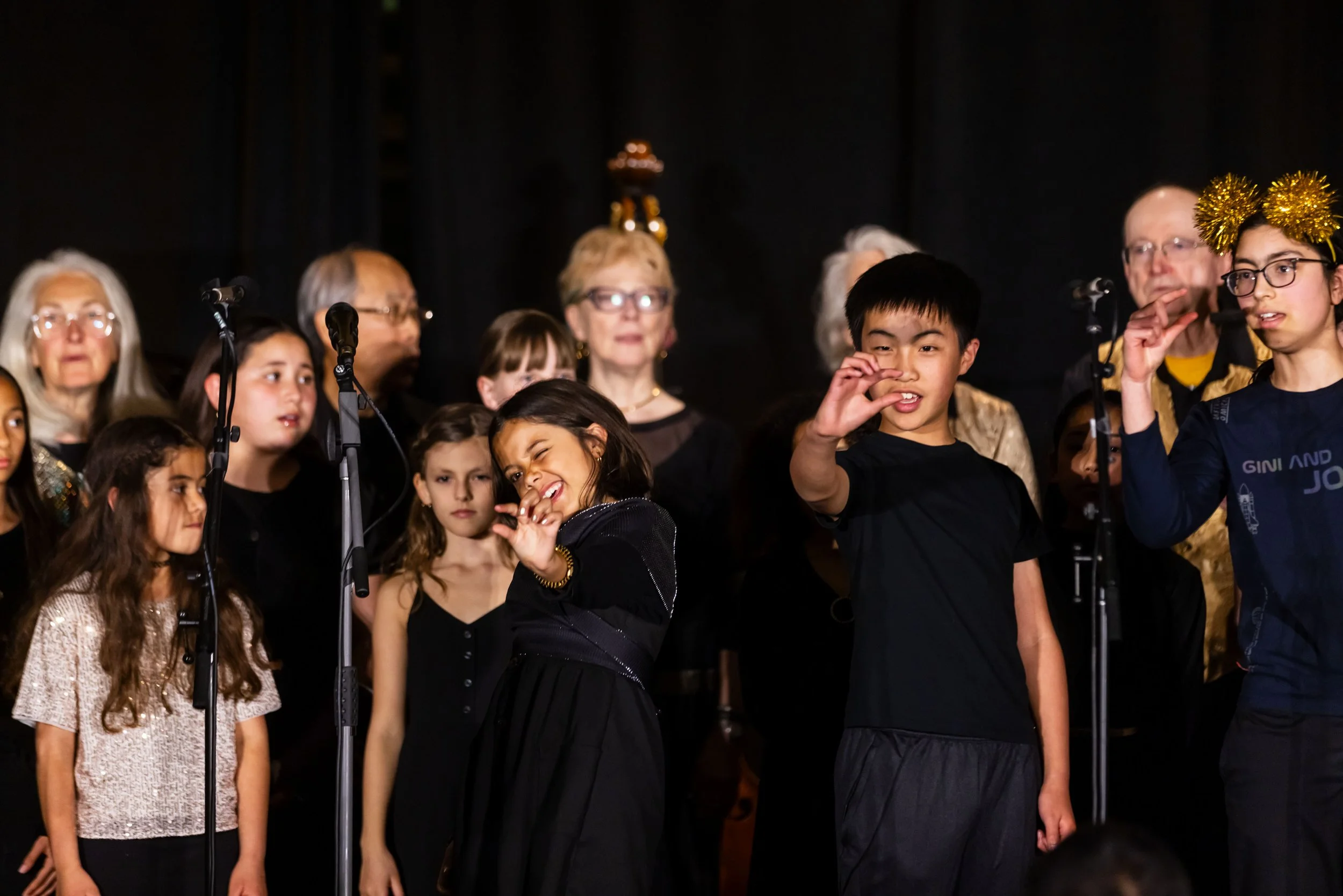
CMC Children's Chorus and Intergenerational Singers perform at CMC Spring Gala 2025. | Photo by Drew Altizer | Courtesy of CMC
2) What is the best example of the way you’ve seen your organization’s work make a difference?
”The NVBA chorus is the only place in my life where I can walk into a private room or a public space knowing my appearance, my presence, my very existence is not going to be met with discomfort, withdrawal, fear, anger, judgment, rejection, unkind words, unkind questions, confusing accusations, hostility, shaming and/or threatening comments, or objects thrown at me or smashed against my body, or be punched, kicked, shoved or threatened just because I exist. Chorus is the only private or public place where I do not need to watch or wait for harm. I can be unguarded and sing and feel joy and playfulness and safety in the welcoming, collectively created harmony. I can relax and take risks and find encouragement, acceptance and friendliness. We are giving this to each other and showing the world it is possible.” - Anonymous New Voices Bay Area TIGQ Chorus member
CMC is working to establish a free, safe community that takes care of our students and allows them to take risks, where people are empowered to use their creativity to meet community needs and solve problems. In developing learning and practice cohorts for our students, we amplify voices that are often silenced, providing them with an outlet to share their own stories and facilitate community transformation in the process. Participating at CMC, students sense that they are accepted, respected, and understood. Faculty encourage creativity and personal expression, customizing their teaching to meet individual needs and connecting music training to the support of community vibrancy. Students, faculty, and staff support and contribute to the living legacy of the Calle 24 Latino Cultural District and the wider Mission District, as a place where all cultures are welcome and belonging extends across genders, ethnicities, income levels, and political affiliations. Many of our students enroll as children, return as teachers, and later enroll their children, forming multi-generational bonds that are rare in the nonprofit arts sector.
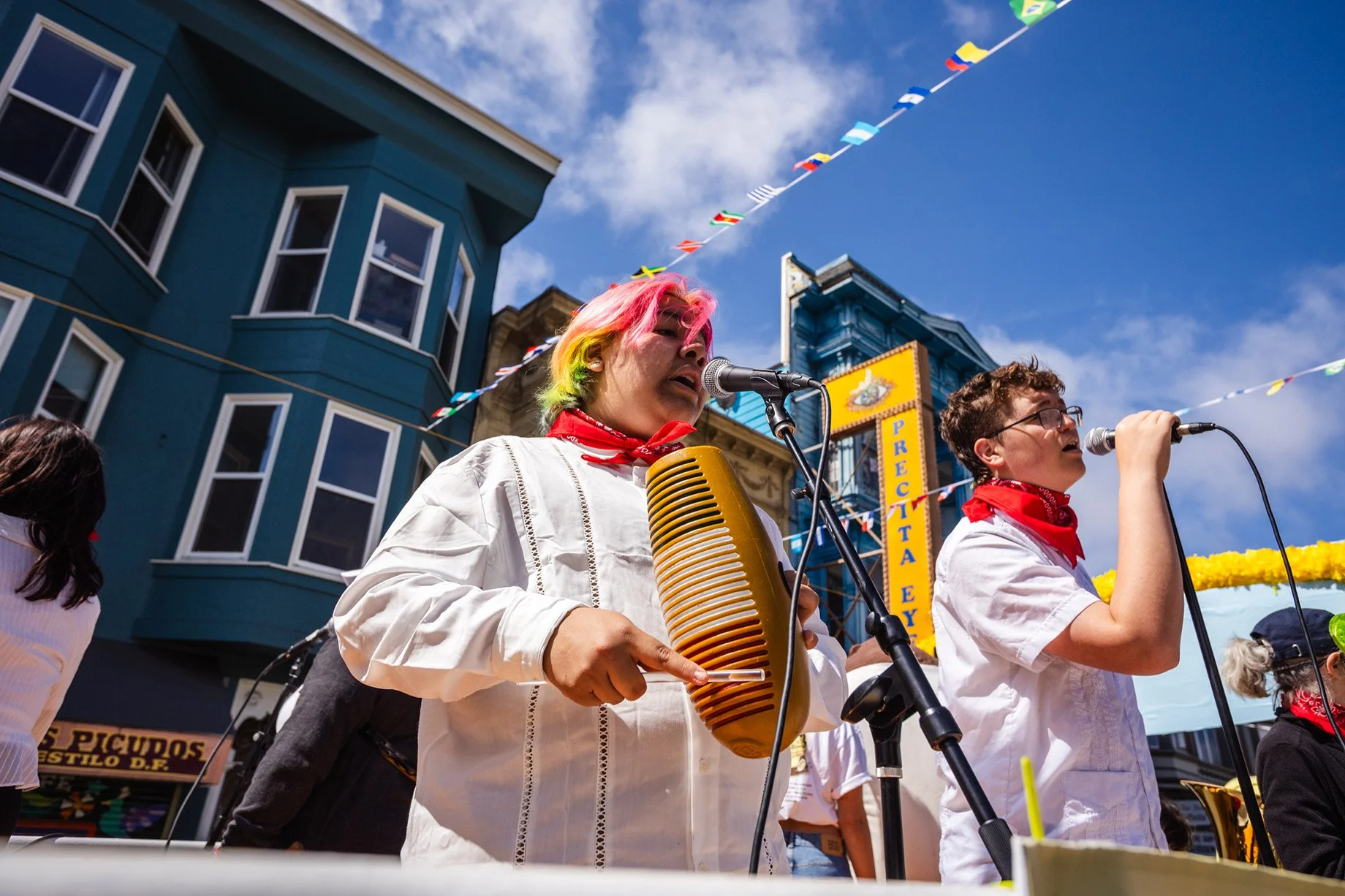
Mission District Young Musicians Program (MDYMP) perform on a float in the Carnaval SF parade 2025. | Photo by Killian Page/What Gives Photography | Courtesy of CMC
3) What are some upcoming initiatives that you are planning for?
CMC’s 2025-2030 Strategic Plan prioritizes four essential areas:
- Deepening tuition-free and sliding-scale programs, ensuring that cost does not limit or prevent participation.
- Expanding existing sequential learning pathways that build artistic skill, personal confidence, and long-term success.
- Strengthening and diversifying the teaching-artist workforce, including training new educators, many of whom will return to teach in their own communities.
- Ensuring continued study for our Richmond branch students, with a focus on securing a long-term home for our Richmond District Branch, which serves nearly one-third of our students, following the pending loss of the facility where CMC has been a dedicated renter and partner for more than 40 years.
If realized, the 2025-2030 Strategic Plan will enable CMC to:
- Significantly increase the number of youth served at CMC, in public schools, or at partner sites.
- Increase need-based tuition assistance by at least 25%,
- Train up to 16 new teaching artists every two years; and
- Secure the long-term resources needed by 2030 to sustain CMC’s work for another century.
Ultimately this plan positions CMC not only to meet the needs of today’s San Francisco, but to help shape its future, one in which every child and family has a place to learn and thrive. With partners who share this commitment, we will ensure that community-rooted music education remains a powerful force for belonging, resilience, and opportunity citywide.
Emboldened by our recent Mission District campus expansion, and the richness of our SFUSD and neighborhood partnerships, we want to expand access by working in early childhood contexts and serving children in beacon schools in our neighborhoods, to address the cultural equity gap in the broader community and extend the benefits of music education to a larger group of youth. Based on feedback from parents, partners, and SFUSD, we know adding a tuition-free branch of our CMC Sparks instrumental classes for 4th and 5th graders would be enormously beneficial. We also know there is a need to grow tuition-free and sliding- scale opportunities for those who do not currently qualify for CMC tuition assistance.
Finally, we know that motivated youth flourish when they have opportunities to excel and play in multiple environments. We would love to give advanced students a sequential tuition-free pathway to master classes, summer workshops, community performances, participation in adult ensembles, and support for creating their own student-led groups.
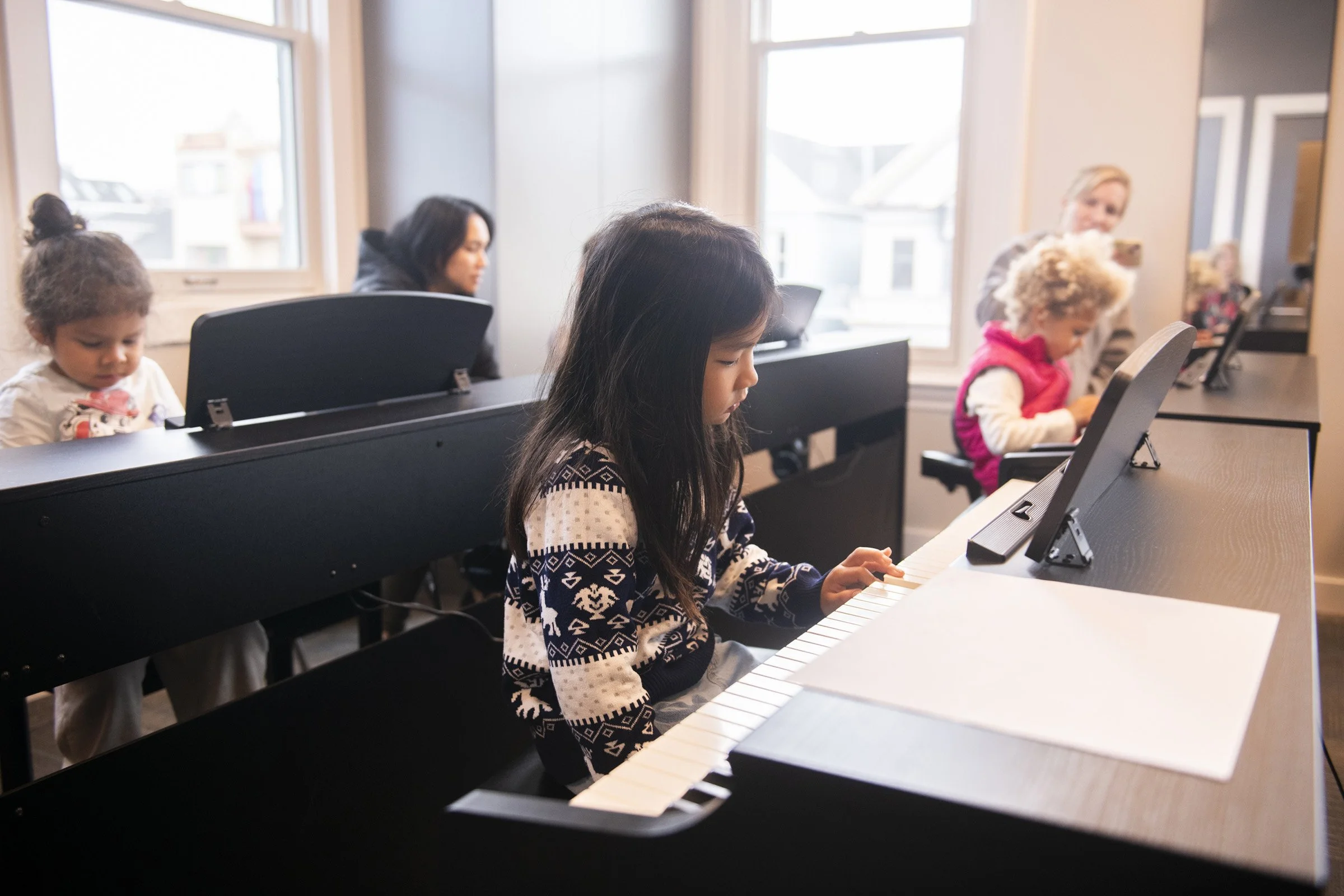
Introduction to Piano demo class (CMC Sparks Program) at CMC Open House 2025. | Photo by Linda Cicero | Courtesy of CMC
4) What is the greatest challenge your organization faces?
The heart of our Strategic Plan, and what will ultimately determine its impact, is a commitment to long-term financial strength. Attaining this next level of sustainable infrastructure, and the revenue to support it, is our organization’s greatest challenge. CMC will launch the most ambitious fundraising campaign of its history, building lasting operating and endowment funds that stabilize tuition-free access, strengthen family supports, and ensure that CMC remains San Francisco’s most welcoming and accessible place for high-quality community-based music education.
5) What does the power of music mean to you?
We believe in the power of music to connect people, celebrate cultures and transform lives. We envision students and faculty who are engaged and fulfilled in making music together, and audiences who are energized by their experiences. Inspired by their training, our students are empowered to find their own voice, develop lasting relationships, embrace learning, and give back to their communities.
This vision reflects a philosophy shared by many of the nation’s most effective community music schools: meeting young people where they are, ensuring that every child can experience musical excellence, supporting the whole family, and providing creative outlets for adults and older adults. When young people see their culture reflected, and when they are guided by teachers who deeply understand their communities, confidence grows, identity solidifies, opportunities become real, and the outcomes extend far beyond music.
6) How will the Music Matters grant be used?
The Music Matters grant will support CMC’s core programming and tuition-assistance offerings. $2,500 provides free 30-minute private lessons for one student for a full year.
—
Learn more about San Francisco Community Music Center.
Header photo by Frank Nuñez/Vivid KZ | Courtesy of CMC.